

As Batmania
 swept the country in the 1960s, Hanna-Barbera
 Productions set out to add some animated superheroes to their Saturday morning slate. Designer Alex Toth
 was given the task of coming up with a “Batman in space,” resulting in the mysterious avenger who could fly, turn invisible, and by way of his forearm-gauntlet power bands, shoot various force rays that could freeze, burn, destroy or pile-drive anything in his way.
 Premiering on CBS in 1966, each episode of SPACE GHOST
 featured two 7-minute adventures sandwiching a DINO BOY tale (about a lad in a prehistoric land). Simple kid stuff, to be sure, but Space Ghost stood apart from the legion of Saturday morning superheroes due to Toth’s sleek design, personified by the inimitable voice of future LAUGH-IN
 announcer Gary Owens and set to a jazzy soundtrack suitable for slaying insectoid villains.
  Merchandising came quickly in the forms of coloring books, puzzles and bubble bath. In 1966, Gold Key Comics produced one issue of a SPACE GHOST comic book and the character appeared in the anthology HANNA-BARBERA SUPER TV HEROES alongside Shazzan
 (not to be confused with Shazam!), the Galaxy Trio
 and others. Those tales, however, despite being beautifully drawn, were usually as slight as their animated inspirations.
 A bit more depth was found in the 1968 Big Little Book, SPACE GHOST AND THE SORCERESS OF CYBA-3, written by Don Christensen and illustrated by Dan Spiegle (who also drew most of the Gold Key comic stories). In the book, our heroes are tricked into returning the beautiful Queen Satanari (that name shoulda’ been a tip-off) to the planet from which she’d been exiled after using scientifically-enhanced magic to burn its cities and force men to battle to the death!
The growing fear of cartoon violence by hand-wringing watchdog groups put Space Ghost into limbo in 1968, but the character had made too powerful an impact to lay dormant forever.
Marvel Comics’ HANNA-BARBERA TV STARS #3 (1978) included a Space Ghost story, “Pilgreen’s Progress” about an old man flying an electric-powered flivver-ship through space in search of a low-tech world. Written by Mark Evanier (a proficient scripter for comics and TV), this charming tale was the only time Alex Toth ever drew the character in a comic book.
1981 saw Space Ghost return to Saturday mornings on NBC’s SPACE STARS, alongside the Herculoids
 , Teen Force and Astro and the Space Mutts (yes, the Jetsons’ dog). But the violence-neutered (and poorly-animated) superhero cartoons of that era left little room for any stylized action, and those cartoons are best left forgotten (along with the clunky redesign of SG’s spaceship).
 And then, in 1994, Space Ghost was resurrected for a new audience in Cartoon Network’s SPACE GHOST: COAST TO COAST
 , a Dadaist comedy positing the helmeted hero as a clueless talk show host. Alongside enemies / co-hosts Brak, Moltar and Zorak, Space Ghost cracked wise with celebrities, ushering in the Adult Swim era and paving the way for HARVEY BIRDMAN, ATTORNEY AT LAW
 and THE VENTURE BROS.
The show was a hit, but ironically had a similar effect on Space Ghost that his original inspiration, the ‘60s BATMAN TV show, had on that hero. It took decades (and Tim Burton) for the general non-GEEK populace to think of Batman as anything other than a campy caped crusader. And many old Space Ghost fans were uncomfortable with the new image. Evanier, for example, believes “as much as its makers insisted it was done out of love and respect for the original, it felt the opposite to me.”
But SG:CTC did raise the Astral Avenger’s visibility, and longtime fans could revel in the fact that there was finally a Space Ghost action figure
 (even if they didn’t display the accompanying talk show desk and mug). In 1997, Archie Comics published a rather forgettable one-shot SPACE GHOST comic set in the original milieu, while DC Comics dedicated numerous issues of their Cartoon Network tie-in comics to the comedic version.
 mini-series presented a grim origin story, in which interplanetary policeman Thaddeus Bach discovers that the force is corrupt, and refuses to play ball. In a scene more suited to the Punisher, Bach’s pregnant wife is murdered and he is left for dead on a desolate planet. Bach is nursed back to health by the alien Salomon who gives him the tools that allow him to become Space Ghost and enact his revenge (begrudgingly picking up Jan and a newly-spelled Jayce along the way).
 The story was written by Joe Kelly and painted by Ariel Olivetti in a steroid-infused style that’s more Tom of Finland than Alex Toth. Hyper-realist Alex Ross provided some nice covers, but the look was again at odds with the essence of the character (SG’s diaphanous cape shouldn’t look like real fabric).

 (you heard us). Certainly Space Ghost as a concept is loaded with potential to tell fully fleshed stories, with deeper characterization and MAYBE an origin. But it needs to be FUN, and this series was anything but. Artist / Sculptor Rubén Procopio (who designed a Space Ghost bust for Cartoon Network) recalls Toth’s opinion on the new direction. “As much as I can appreciate the artistic challenge that everyone involved had, my memory of Space Ghost was as a more lighthearted, brighter character. Having gotten to know Alex, I can say that he preferred the characters in a more upbeat, less dark setting.”
 So what’s the future hold for the Guardian of the Galaxies? How about a live action SPACE GHOST movie directed by Brad Bird, whose THE INCREDIBLES
 was a perfect balance of whimsy and superheroics? We cast Bruce Campbell as our square-jawed hero (with Jan, Jace AND BLIP by his side), battling a slinky Spider-Woman (Julianne Moore) and a CG-rendered Zorak! Maybe Gary Owens could even loop the hero’s dialogue, although the legendary voice actor has another idea. “I could play Zorak because that’s how I look in real life.”
 It’s surely only a matter of time before someone else tackles the Interstellar Spectre. Mark Evanier summarizes the character’s appeal: “There’s something very primal about him. I remember watching the first episode and thinking he felt like a hero who’d been around forever with a fully developed universe and backstory.” Adds Procopio, “Not to mention those wonderful villains and secondary characters that Alex designed. The show inspired a whole generation of artists.”
In the meantime, fans of the character can geek out to both CTC and the original 1966 series on DVD (the latter of which also features a great documentary on Alex Toth, who died in 2006) and yell along with Gary Owens as he bellows the eponymous battle cry of the coolest space hero ever: SPAAAAAAACE GHOOOOOOOOST!
Sorry, it’s a written law that all articles on the character need to end that way.
_____________________________________________________
ORIGINALLY PUBLISHED in GEEK MONTHLY #20, October 2008


 ” may be the biggest budgeted film to originate as a cheap chunk of plastic, but it’s certainly not the first. Let’s take a look at the short history of movies based on toys.
  . The rag doll created by illustrator
  in 1915 for his daughter became a book character in 1918, coinciding with the mass-manufacturing of the doll (the birth of synergy?). In 1941, Ann was joined by brother
  in the first of a series of animated shorts by the Fleischer studios. Decades later, 1977’s “Raggedy Ann & Andy: A Musical Adventure” was the first time a consumer toy was the star of a theatrical motion picture. The film has a retro-surrealist vibe that has more in common with “Alice in Wonderland” than what was to follow…
 .” It’s an animated spin-off of the
  action figure / TV show line in which Prince Adam is reunited with his long lost super-sister, She-Ra (not She-Woman?), Princess of Power!! “SotS” was actually a number of episodes of the forthcoming “She-Ra” TV show edited together to create a full length movie, making the cheap animation’s flaws even more glaring on a giant screen. And thus, the toy-film boom was born!
  ,” in which the jolly Ursae from Care-a-lot try to convince some gloomy kids that life is better if you only show you care… and buy a stuffed animal with a symbol on its belly. The darn thing grossed $23 million, launching a TV series and two movie sequels, 1986’s “
 ” and 1987’s “
 ,” which was NOT full of allusions to psychedelic drugs. Unless you want it to be.
 ” pitted the flying-horse-riding moppet dressed like a bad ‘80s pop star against an evil princess (these movies have a lot of malevolent royalty) out to destroy all color in the world. Both Rainbow Brite and the Care Bears were first created for use on children’s greeting cards, but the toys followed in short measure (and did prefigure the TV cartoons).
  ” dealt with a resentful witch creating “smooze,” a slime designed to turn their pastel-colored world gray and change the perky ponies’ personalities to sullen! Considering how garish the ‘80s were, especially in retrospect, we can’t help but wish at least SOME smooze would’ve taken over.
 ” tried to take advantage of the lack of kid-TV censorship by adapting a much darker tone, which involved having one character swear and killing off numerous Autobots, mainly the fan-favorite Optimus Prime (voiced by Peter Cullen, who also played the character in the series as well as the new film). The movie is infamous in that it was the legendary Orson Welles’ final job. The “
 ” auteur never lived to see the finished product (not that he ever cared to). Perhaps America wasn’t ready for the more extreme Japanese style of animation as the PG-rated movie fared so poorly at the box office that it caused the studio to send “G.I. Joe: The Movie” straight to video and the world never saw the planned Jem and the Holograms film.
 ,” with Dolph Lundgren donning the loincloth and broadsword of the action figure known so laughably as He-Man. In the film, He-Man and a few Eternian pals are accidentally transported to Earth to save money on set design by the producers, er, the Cosmic Key and have to find a way to return to their world and defeat Skeletor before he gains the power of Grayskull! Frank Langella plays arch-villain, adding to an enormous geek résumé which includes Dracula, Star Wars, Star Trek, Sherlock Holmes, Zorro and Superman movies and TV shows.
  .” Set during the 1950s, it’s a flashback story of how Marvin McNasty plans to steal the Bone of Scone (which grants “puppy power” to dogs… and cats, too for marketing purposes) and use it to take over the world. By this time, even the most patient parents had no doubt had their fill of these poorly-animated advertisements… at least on the big screen. The new destination for this kind of product was home video.
 ” (based on the Fisher-Price toys about a squad of everyday heroes including firefighters, police officers, forest rangers and, uh, construction workers), almost seemed to have gone into theaters by accident. A few weeks after release, it was available on home video. The same thing happened last year when “
 ” (which was not an animated remake of the Patsy Cline story) snuck into a few theaters before quickly coming to DVD.
  ” transforming those tarty dolls into live action. And in 2009, He-Man makes a movie comeback in a big budget film rumored to be done using CGI backgrounds and effects ala “300” (with presumably as many exposed rippling male abs). But we’re most excited for Richard Linklater‘s “Play-Doh Fuzzy Pumper: the Motion Picture,” an R-rated psychodrama starring Matthew McConaughey and Rosario Dawson.
 .” Will the free-associating fast food icons be able to stretch their shtick into a full-length adventure or will AQTF be added to the list of cartoon movies (animated or translated to live action) that should’ve stayed on the small screen?
 , Casper the Friendly Ghost,
  , Mr. Magoo, the Pink Panther and other Saturday Morning TV staples originated in animated theatrical shorts. But what happens when characters created for TV become movie stars?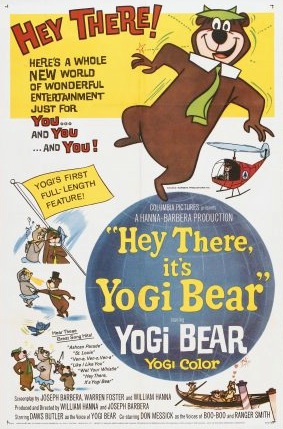
 ” (1964) follows the ursine pick-a-nic basket thief and his pal Boo Boo on a cross country trek to rescue Yogi’s girlfriend Cindy from nefarious circus folk. 1966’s “
 ” satirized the spy genre, with Fred, the patriarch of the modern stone-age family recruited to take the place of an injured secret agent who looks exactly like him (did Chris Rock’s “
 ” steal its plot from this film?). It wasn’t until 1990 when the next animated H-B feature, “
 ” dropped into theaters like a lead sprocket.
 ,” starring Dave Thomas and Sally Kellerman as the Pottsylvanian spies from the classic
  of the 1960s. But the film makes almost no attempt to ape the lightning-quick, razor sharp satire of
  , the actors don’t bother to imitate the spies’ iconic accents and “moose and squirrel” get mere lip service. Sadly, 2000’s “
 ,” despite much bigger names and budget, didn’t fare much better. The lead characters are rendered in CG, alongside Jason Alexander as Boris, Rene Russo as Natasha and, amazingly, Robert DeNiro as Fearless Leader. The movie’s self-referential plot is too convoluted to even get into, and while an earnest attempt was made to capture the rat-a-tat style of the cartoons, it just doesn’t work.
  ” and 1999’s “
 ” (both starring Brendan Fraser) likewise failed to capture the manic energy of the originals. It’s simply a case of clashing esthetic requirements. The
  were perfect for
  and over-the-top characterizations. Turning the extremely exaggerated cartoons into real people in a 90-minute story was a bad idea from the get-go.
 ,” John Goodman and Rick Moranis easily fit into the pelts of
  , but Elizabeth Perkins is kind of wan as Wilma and Rosie O’Donnell is just grating as Betty. The story (in which Fred becomes the corporate patsy for an embezzlement scheme) is merely serviceable, and the forced pop music is obtrusive, but the art direction is impeccable. There are tons of nods to the cartoon and the mixture of Jim Henson puppets and CGI to create the prehistoric creatures works well. In fact, this may be the only film where the incidental background elements are what make the film worth seeing! However, the less said about the fully-recast 2000 prequel, “
 ” the better.
 ” (which was based on a
  that was based on a
  that was revamped to match the cartoon… got that?), another iconic H-B series came to life in 2000’s “
 .” Like “The Flintstones,” the movie is most notable for how carefully the look of
  and characterizations were recreated. Matthew Lillard and Linda Cardellini are eerily perfect as Shaggy and Velma, while Sarah Michelle Gellar and Freddie Prinze Jr. merely walk through their parts as Fred and Daphne, appearing even less believable than the titular CGI Great Dane. The 2004 sequel, “
 ” upped the ante by including numerous villains from the TV show including the fun-to-say Miner Forty-Niner.
  ” (taking work away from Keanu Reeves and Alex Winter). When B&B are mistaken for hitmen (hired to “do” the cheating wife of an arms dealer), they embark on a cross country trek that involves peyote cacti, Chelsea Clinton, the destruction of national landmarks and lots of cavity searches. The film was a huge hit, both commercially and critically, with even Siskel & Ebert giving the two brainless boobs two thumbs up. Huh-huh. I said “boobs.”
  .” Matthew Broderick stars as the “
 ” for kiddies, a security guard who gets refitted with cybernetic, uh, gadgets and does battle with the evil Dr. Claw, played by Rupert Everett. The film ill-advisedly attempts to be logical and create a somewhat darker tone than
  , resulting in a movie that didn’t appeal to fans of the original or their parents.
 ,” the classic British “Supermarionation” show of the 1960s. Using puppets and models, the story of the Tracy family and their International Rescue organization was popular enough to spawn two full-length features, “
 ” (1966) and “
 ” (1968). But when Hollywood went all Pinocchio on the Tracys and turned the puppets into flesh and blood actors in 2004’s “
 ,” magic didn’t happen. Despite an attempt to modernize the story into a “Spy Kids” pastiche, the movie still felt too corny for the kids and not enough for old fans of the original series.
 could always be relied on for some urban snaps, funky tunes and a dollop of moralizing on Saturday mornings. In the 2004 “
 ” movie, the kids literally leap out of the TV cartoon and into contemporary live action. Albert (Kenan Thompson), Mush Mouth, Dumb Donald and the rest look right, sound right, and even have some funny bits, but the movie is so sterile and safe and sanctimonious (not to mention shameless in its repeated plugs for DVDs of the original cartoon) that you kinda wish the kids would’ve popped into the middle of a real gang fight (the movie even contains a slight dig at hip hop, no doubt at the insistence of its cranky creator, Cosby).
  ” (1990), “Doug’s 1st Movie” (1999), “
 ” (2001), “
 ” (2002), “
 ” (2002), “
 ” (2002), “
 ” (2004) and three (count ‘em) different “
 ” movies!
 (which originally aired as part of MTV’s
  series in the early ‘90s) was more about style than substance, with little (sometimes no) dialogue, a lack of continuity between episodes and an emphasis on cool imagery. But mainstream movies are obsessed with exposition, and so the live 2005 “
 ” movie tried to fill in all the holes. Of course, few fans approved. In the title role, Charlize Theron is chunky compared to the Egon Schiele-inspired cartoon, but she’s actually not bad, especially given the convoluted assassination / coup plot she has to leap through.
 ” freed Trey Parker and Matt Stone from the constraints of network TV, fulfilling the promise of their hilariously obscene 1995 “Spirit of Christmas” short that launched the series. The movie is a blistering critique of censorship, containing more profanity than a Scorsese film and some truly catchy musical numbers that put all that saccharine Disney piffle to shame. Sadly, as with most great satire, the people who needed to see it the most didn’t even give it a chance (including Saddam Hussein).
  ", and
  ,
,  and Mighty Mouse are all on the way as well. Not to mention “
 ,” but that falls into an entirely different category: syngergistic toy/cartoon hybrids that became movies (which we’ll tackle when that movie hits, “